EllipticToken
Contents
our goal is to steal the tokens that Alice just redeemed by using the fact that Bob skipped parts of the ECDSA algorithm
Challenge Info
- Platform: Ethernaut
- Challenge: EllipticToken
- Category: Blockchain
| |
so the first thing the challenge description tells us is that Bob creates vouchers off-chain for a receiver (Alice in this case) and then Alice redeems the voucher, by looking at the challenge code we notice that the function redeemVoucher is the one used for the redeeming process
the challenge description tells us that our goal is to steal the tokens that Alice just redeemed by using the fact that Bob skipped parts of the ECDSA algorithm
to solve the challenge, lets start by looking in the contract for any logic that allows us to steal Alice’s tokens. After analyzing the code we can notice that the only line that actually does that is _approve(tokenOwner, spender, amount); located at the end of the permit function, and this will only work if tokenOwner is Alice’s address and amount > 0
so tokenOwner is computed in this line :
address tokenOwner = ECDSA.recover(bytes32(amount), tokenOwnerSignature);
this means in order to make it equal to Alice’s address we should craft a pair amount,signature that gets verified into Alice’s address
if you notice, recover is using the amount directly without hashing it, this is actually a vulnerability in ecdsa verification, the message should be hashed before verification, so we can say/assume that this is the missing step the challenge description talked about
for now we have 2 useful information :
1- we should make tokenOwner equal to Alice’s address
2- the message isn’t hashed, this should be the thing we will abuse
from now i will be talking about my attempts :
1- use the same hash and signature used in the redemption
we stated before that Alice just redeemed the voucher, so the function redeemVoucher should have been called and executed after we deployed that challenge, and since Ethereum is a public Blockchain, we can read the exact parameters values used in the call
ethernaut challenges are deployed in sepolia testnet, lets go and find the contract challenge there :
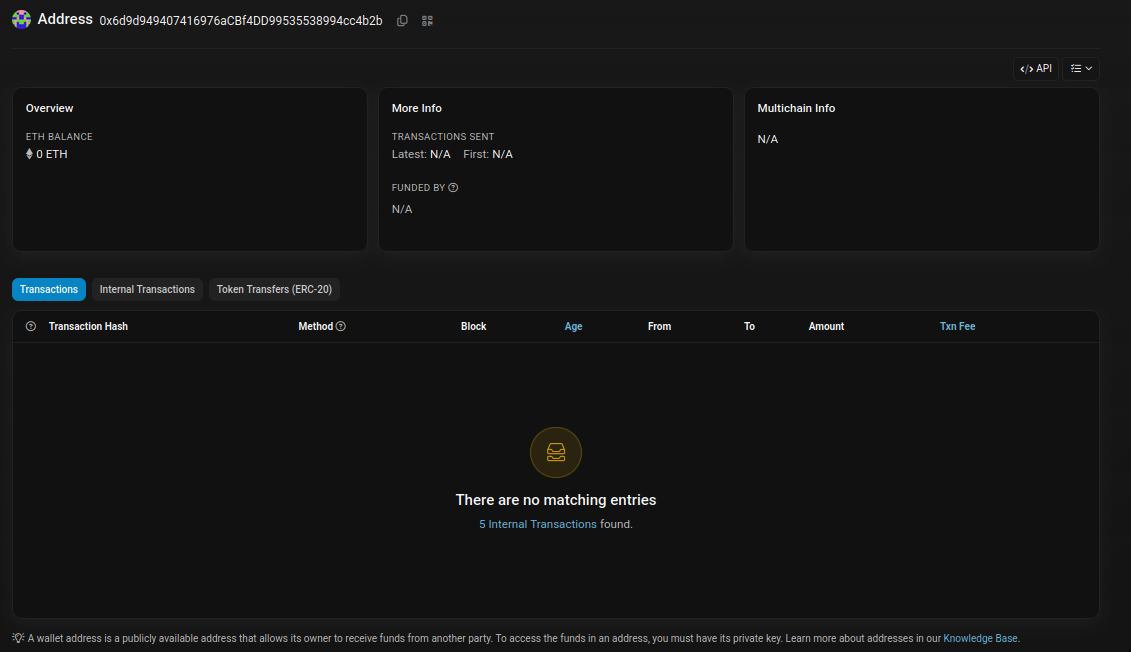
now by our previous assumption, there should be a transaction that called the redeem function, but where is it ??
well the explanation for this is that the initial transaction that started the challenge instance is the one that called the redeem function, so the call we are looking for will be found inside an internal transaction
so we check the internal transactions :
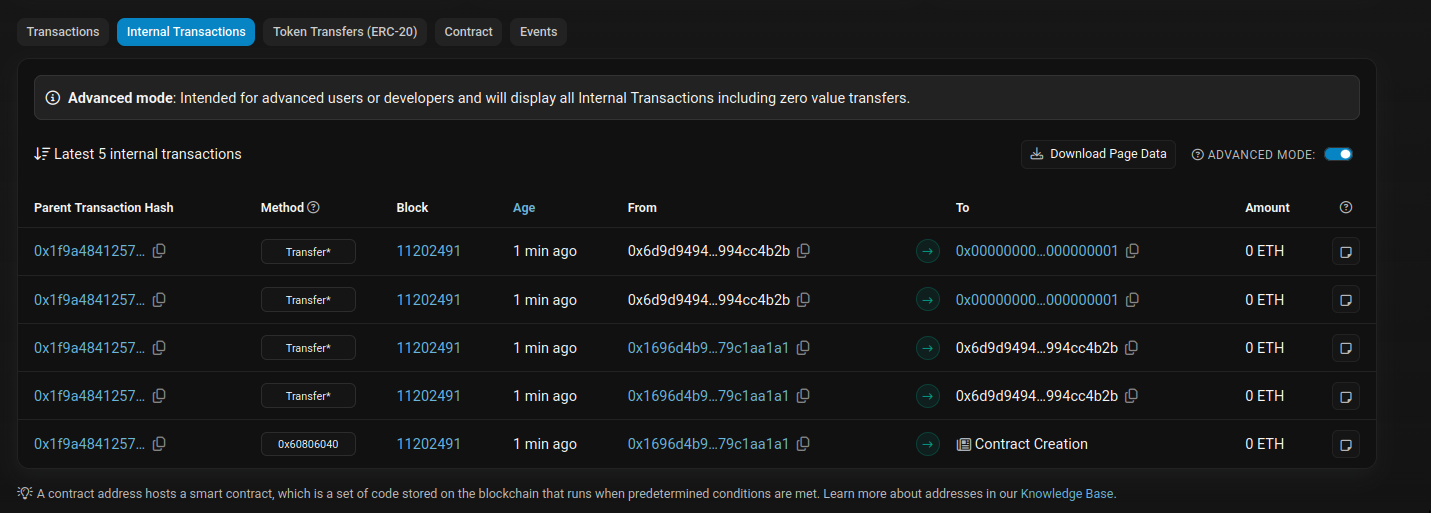
we go more deep and click on the parent transaction hash :
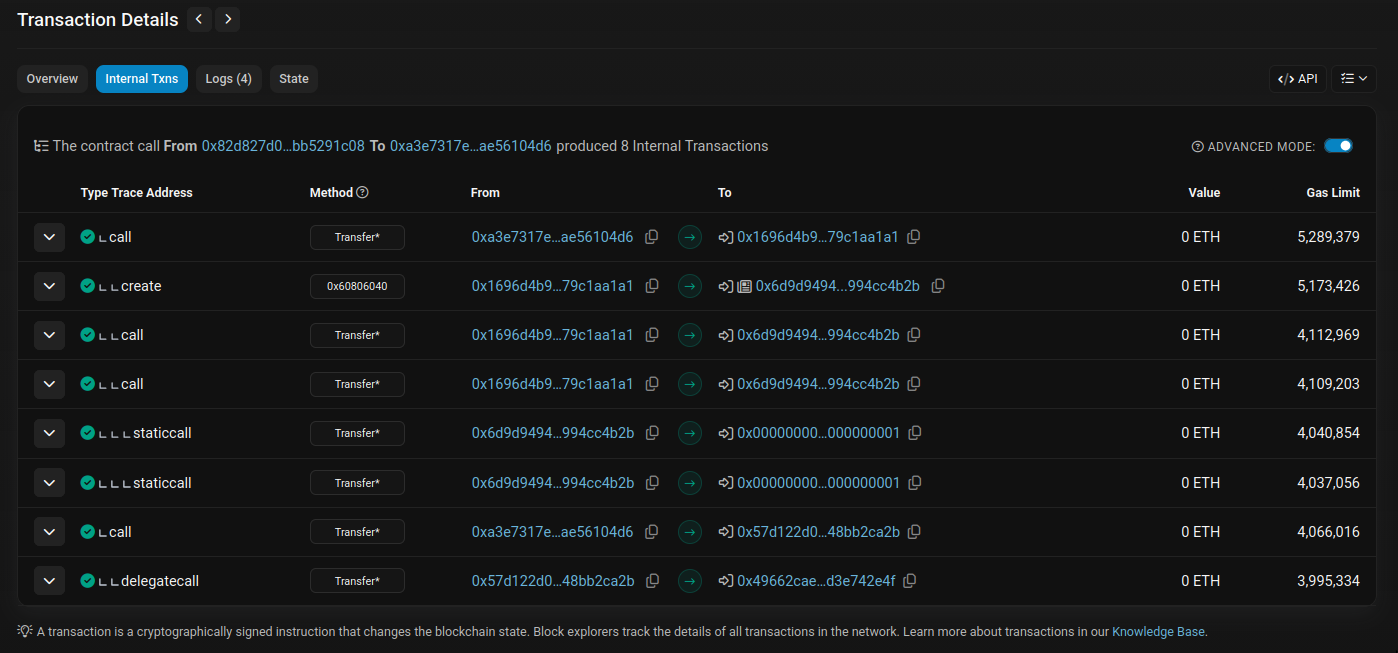
the call type for the function should be call, by checking the calls calldata the 4th is the one we are looking for

this is the bytecode
now to get the values of the parameters we execute this commend :

this will match each argument with the input value
the output will be :

this is actually a good advancement, we now have the value of :
- amount in the voucher
- the salt used for hashing
- Alice and Bob signatures
what we can do by these is : compute the same exact voucher hash that was used in the redeeming process, and since we know Alice’s signature for this hash, we actually have a valid pair that verifies to Alice’s public address
while i was doing this work, i thought it would work because in the permit function when they are not hashing, was an implementation typo, so they would only check if the hashed value of amount is used, but they are actually checking that in this line :
require(!usedHashes[bytes32(amount)], HashAlreadyUsed());
(yup i didn’t read all the code carefully :/)
now my plan will not work!! because the idea was to cast the hash value we computed before into uint256 and then use it as the amount, and they would check its hashed value only
well, hopefully there is a save for this!
lets take a look at ECDSA.recover to see how it works
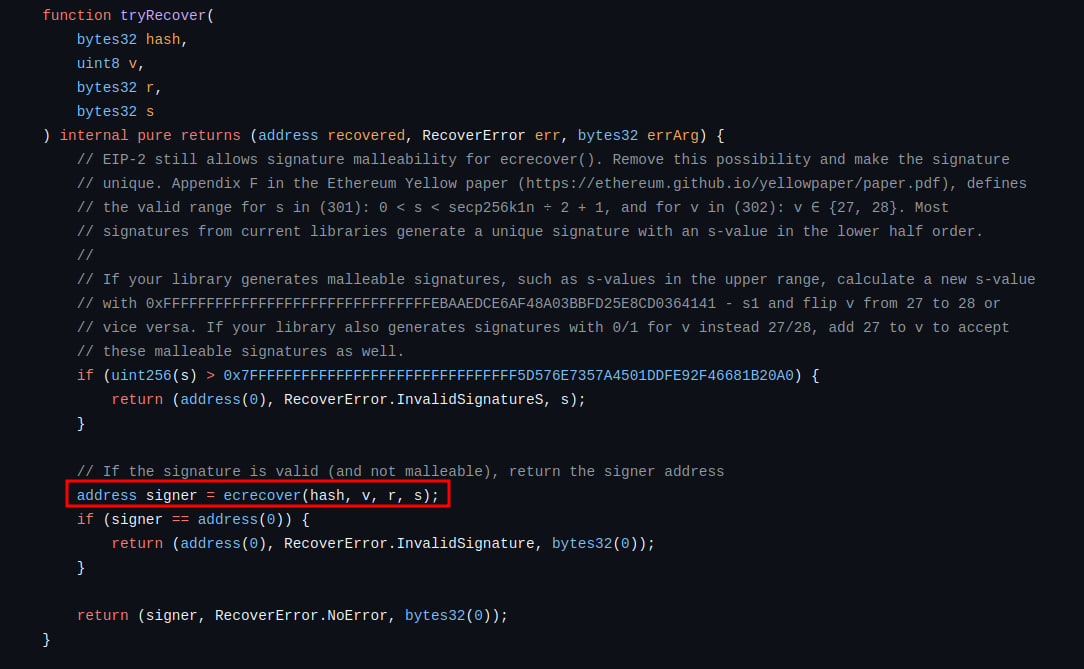
without digging into all the code details, all we need to know is that this line is the one responsible for recovering the signer address (Alice’s public address)
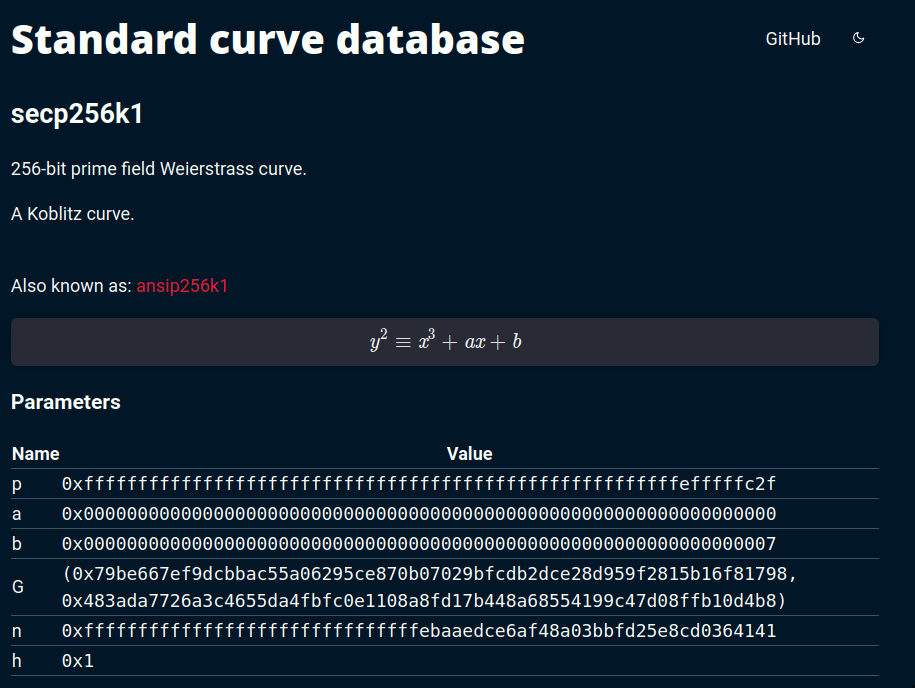
ecrecover is a built-in solidity function that implements the ecdsa verification algorithm, the curve used is secp256k1 :
lets go one step deeper and look at how the recovery is done (this is my favorite part ^-^) :
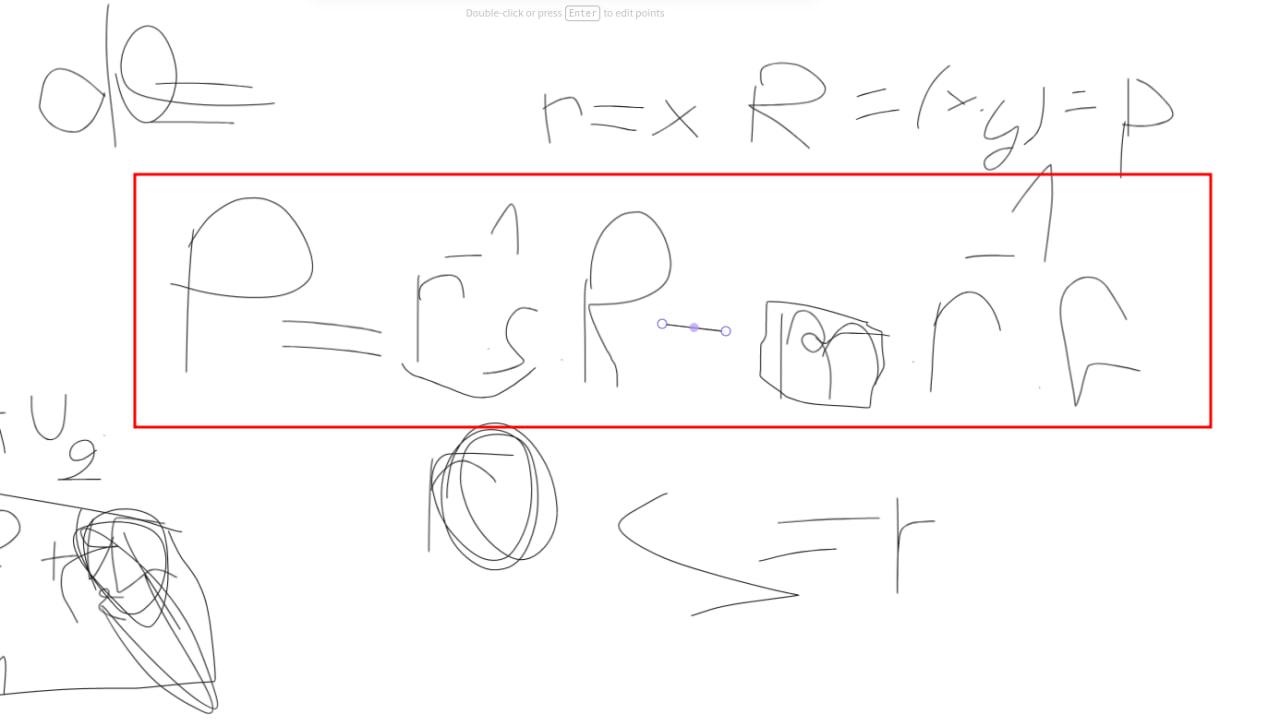
so this some of my writing while i was solving the challenge (sorry for the ugly drawing haha)
as we can see this is how the public point of the verifier is computed (and then from it they compute the address)
notice that i wrote m*r^-1, generally it is z*r^-1 where z is the hash message, but since they are not hashing in the challenge, i will use m
here we are doing u1*R + u2*R right?! (u1 and u2 are just shortcuts)
the scalars u1 and u2 are mod n, that is because we are working in the elliptic curves group
more precisely u1*R is actually an abbreviation for R+R+R... u1 times, and point addition is done modulo the order of the finite cyclic group of the elliptic curves
with this in mind, it is important to notice that this will open a way for collisions !!
because since we are not hashing, the amount we pass is directly used as m in the verification, and when working mod n, both m and m + n are the same number, but they are different hashes/numbers in the require check
2- use the same hash + n and signature used in the redemption
now since we proved that m and m+n will be equal inside ECDSA.recover, we can uint256(hash) + n instead of uint256(hash) (notice that by hash i mean the voucher hash for Alice they used in the redeem function) and it will pass the require check because it is actually a different value outside the verification
this should solve the challenge, right :) ?
well, i did hit a bad luck :// , hash + n overflowed (>256 bits) and hash - n is negative
the whole work didn’t work at the end

3- i found another solution
remember the previous verification equation, we will use that.
lets forget about trying to use the same signature of Alice, and forge a different signature that recovers Alice’s public address (public point)
this is actually possible because they are not hashing :)
assume we take m = 0 (this wouldn’t be possible in case they were hashing because a hash can’t be zero)
the equation will become : P = u1*R, where u1 is r^-1 * s
what would happen if we choose r = Px (the goal is to make R = P) , and s=r, in this case u1*R will be equal to P, where P is the public point of Alice, This is the solution for the challenge for sure !!
well for m=0, we will steal zero tokens, but we can take m = n which is equivalent to 0
now there is something missing to fully craft this exploit, which is the x coordinate of P
we can’t get it directly from Alice’s address, that is just a part of the hash of P
recovering the x coordinate of Alice’s public point
we stated before that we have a valid pair the verifies to Alice’s public point, which is the signature and voucher hash
first we compute R
we are still missing the y value for R, we compute it like this :
from sage.all import *
p = 0xfffffffffffffffffffffffffffffffffffffffffffffffffffffffefffffc2f
a = 0
b = 7
E = EllipticCurve(GF(p),[a,b])
r = 0xab1dcd2a2a1c697715a62eb6522b7999d04aa952ffa2619988737ee675d9494f
s = 0x2b50ecce40040bcb29b5a8ca1da875968085f22b7c0a50f29a4851396251de12
z = 0x87f1c8cd4c0e19511304b612a9b4996f8c2bd795796636bd25812cd5b0b6a973
n = 115792089237316195423570985008687907852837564279074904382605163141518161494337
r_inv = pow(r,-1,n)
G = E(0x79be667ef9dcbbac55a06295ce870b07029bfcdb2dce28d959f2815b16f81798, 0x483ada7726a3c4655da4fbfc0e1108a8fd17b448a68554199c47d08ffb10d4b8)
yy = pow(r,3,p) + 7
y = modular_sqrt(yy,p)
if y%2 == 1 :
    R = E(r,y)
Alice’s signature is (r,s,v) where v tells us which y we take (modular_sqrt returns 2)
v was 28 which means y should be odd (we take the even value if v=27)
after recovering R we compute P by : (python code)
P = r_inv * s * R - z * r_inv * G
and this is the solidity code i used to extract r,s,v from Alice’s signature:
 bytes memory signature = hex"ab1dcd2a2a1c697715a62eb6522b7999d04aa952ffa2619988737ee675d9494f2b50ecce40040bcb29b5a8ca1da875968085f22b7c0a50f29a4851396251de121c";

    bytes32 r;
    bytes32 s;
    uint8 v;

assembly ("memory-safe") {
    r := mload(add(signature, 0x20))
    s := mload(add(signature, 0x40))
    v := byte(0, mload(add(signature, 0x60)))
}
    console.logBytes32(r);
    console.logBytes32(s);
    console.log(v);
this is the x value we recovered :
23454111434303081435929071042469611746672141632665808216069109536628528697239
now we craft our signature by setting r = s = x and v = 27
there is an extra security alert that forbids values of s > n/2, in our case s was smaller, but if it weren’t, can simply replace s by n - s and set v = 28
     bytes memory tokenOwnerSignature= hex'33da8e7fe906411e4fc12842632ec77c2aee6a4324a4a3ca554b56667e4ccf9733da8e7fe906411e4fc12842632ec77c2aee6a4324a4a3ca554b56667e4ccf971b';

     uint256 amount = 115792089237316195423570985008687907852837564279074904382605163141518161494337;

     bytes32 permitAcceptHash = keccak256(abi.encodePacked(0xA11CE84AcB91Ac59B0A4E2945C9157eF3Ab17D4e,0x284Cd6B2b7D4dC8a754c8fC34858529db5039eBb, amount));
these are the values we will be passing to the permit function, last thing is we compute the signature for permitAcceptHash using our private key, this is straight forward
we can check that they recover to Alice’s public point by running :
address tokenOwner = ECDSA.recover(bytes32(amount), tokenOwnerSignature);
and print the address
after checking that we are correct, we execute :
instance.permit(amount,0x284Cd6B2b7D4dC8a754c8fC34858529db5039eBb,tokenOwnerSignature,spenderSignature);
where 0x28... is the address i will transferring tokens to
and we solve the challenge by stealing the tokens using :
_approve(tokenOwner, spender, amount);
this is the full solidity code :
| |
**resources :
for elliptic curves, i would recommend :
https://rareskills.io/zk-book module 1, chapter 4 to 9, it has one of the best explanations i found about groups and elliptic curves, looking at elliptic curves as a group and finite field is actually really helpful
https://github.com/elikaski/ECC_Attacks this repo is also good, i like the explanation
https://cryptohack.org/challenges/ecc/ this challenges can help you understand and apply more
https://hackropole.fr/fr/crypto/ you can find more difficult challenges here
THANK YOU !!! IF YOU READ THIS I REALLY REALLY APPRECIATE YOUR TIME